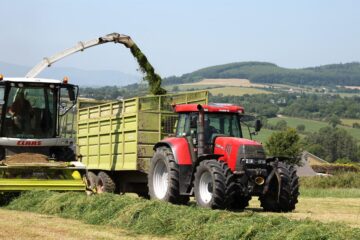
Walk through most sheds around Foulksmills this week and you’ll see the same picture: cattle in, silage pit open, and the finishing pens starting to fill. From now until the spring, what goes in front of those cattle every morning decides how quickly they hit the factory spec and what it costs to get them there.
The bulk of the questions coming into the yard this month are about meal for finishers. So here’s how we look at it, and where our own FibreGold Beef 14% fits.
Start with the silage, not the meal
The single biggest thing that decides how much meal a finisher needs is the quality of the silage in front of it. Teagasc’s figures put it plainly: for a 600kg steer gaining about 1kg a day, the meal needed runs from roughly 4–5kg a day on top-quality silage (around 74% DMD) up to 7–8kg a day on poorer silage (around 66% DMD).
Every unit of DMD lost means about a third of a kilo more meal a day to hold performance. Over a 100-day finish, Teagasc costed that gap at about €263 per steer on the poorer silage versus €158 on the best, at their assumed meal price. Across a shed of 50 cattle, that’s real money.
So if you haven’t had your silage tested yet this winter, that’s the first job. It’s a small cost and it tells you exactly what you’re working with.
Bring meal in slowly
Rushing cattle onto high levels of meal is the quickest way to run into acidosis and setbacks. Teagasc’s guidance for finishers:
- Build meal up gradually over about three to four weeks.
- Keep forage at a minimum of around 10% of total dry matter intake.
- On ad-lib systems, never let the meal run out, as cattle that go without and then gorge are the ones that get into trouble.
- Clean, fresh water available at all times.
If you see cattle off form, scouring or going off their feed after a step-up in meal, talk to your vet or Teagasc adviser before going any further.
Give them room at the barrier
Teagasc’s November Future Beef newsletter is a useful reminder that space matters as much as the ration. For finishers, they suggest about 600–700mm of feed space per head for concentrates, and say 2m² of lying space on slats isn’t enough, with 2.7m² the minimum. Bullying at a crowded barrier means the shy feeders fall behind and the whole pen finishes unevenly.
Know when to draft
Finishing gets less efficient the longer it goes on. In one Teagasc example over 132 days, daily gain dropped from about 1.13kg to 0.77kg, and cattle needed roughly half as much feed again for every kilo gained in the second half. Their advice is to draft at fat score 3=/3+, rather than holding cattle on expensive meal for marginal gain.
Where FibreGold Beef 14% fits
FibreGold Beef 14% is our complementary ration for cattle, made to be fed alongside forage. Going by the label, it’s built on barley and maize, including flaked maize, with soya hulls and molasses, plus minerals and vitamins. The soya hulls bring digestible fibre into the mix, which is what we want in a ration going into cattle on a high-meal winter diet.
A couple of practical notes:
- It’s for cattle only: the label is clear it’s not to be fed to sheep.
- Always follow the feeding rate on the label, and match it to your silage test and target gain.
- We deliver nationwide, and bulk orders are welcome.
If you’re unsure what level to feed, a quick chat with your Teagasc adviser alongside your silage results is time well spent. For those who want to dig deeper, the Teagasc National Beef Conference takes place in the Hodson Bay Hotel, Athlone, on Monday 30 November at 5pm.
Get in touch
Finishing cattle this winter and looking for a steady, fibre-rich ration? WhatsApp us on 087 283 2443 for a quote, email accounts@kehoefarming.com, or contact us here. You can also see the full product details on our FibreGold Beef 14% page.
Sources: Teagasc – Nutritional management of finishing beef cattle; Teagasc – Key principles of feeding concentrates to growing-finishing cattle; Teagasc – November 2026 Future Beef newsletter; FibreGold Beef 14% label data.